
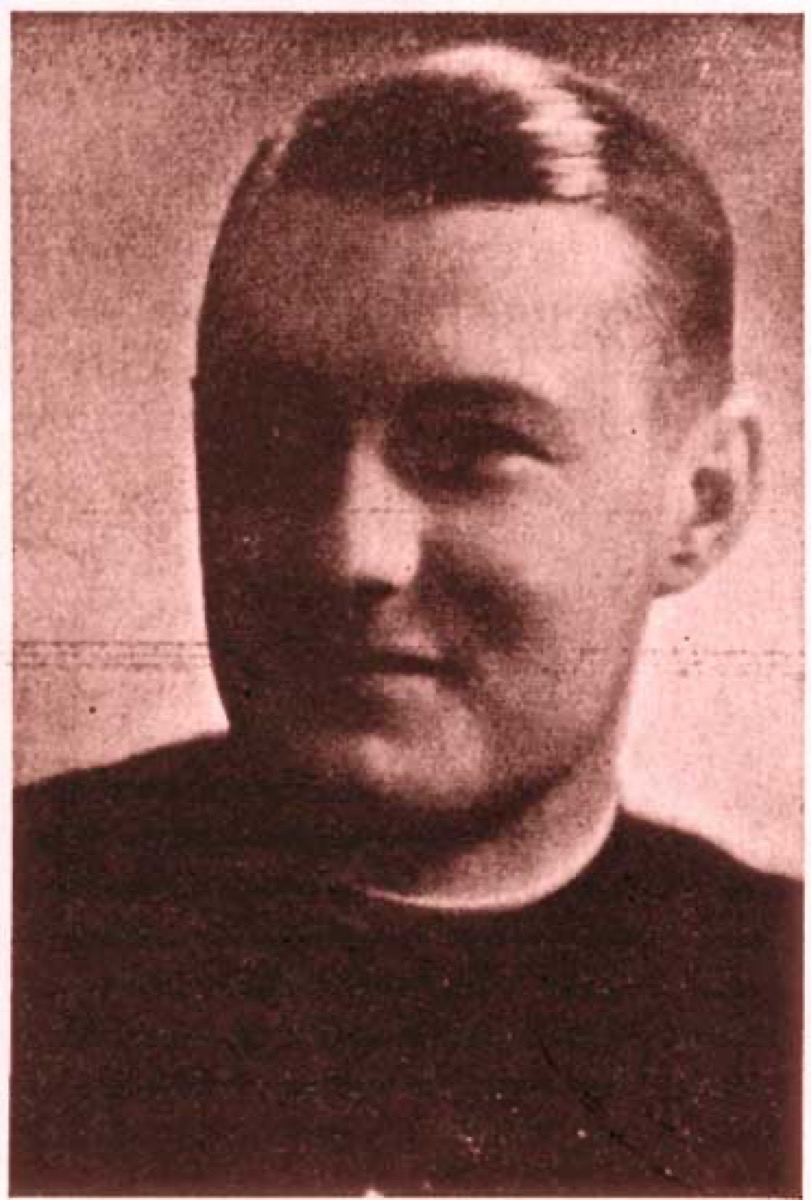
Emmanuel Hanquet
Born on 15 June 1915 in Liège into a large family of fifteen children, Emmanuel Hanquet dedicated his life to faith, education, and humanitarian service. He pursued law studies at the University of Liège from 1932 to 1934 before joining the seminary of the Society of Auxiliaries of the Missions (S.A.M.) in Louvain/Leuven, where he undertook theological studies under the Jesuits. He was ordained a priest on 6 February 1938 in Liège by Monsignor Kerkhofs.
His missionary journey began on 20 November 1938 when he departed for China via Marseille aboard the “Félix Roussel.” Arriving in Shanghai on 20 January 1939, he briefly visited Haimen before studying Chinese at the Hua Wen School in Peking until July 1939. On 10 July 1939, he embarked on a month-long journey to Hungtung (Shansi), where he served as the bishop’s secretary, a teacher, village priest, and bursar.
Hanquet faced the harsh realities of war when he was first imprisoned by the Japanese on 8 December 1941 for four months. After resuming pastoral duties as a parish priest in Hungtung, he was arrested again on 13 March 1943 and interned at the Weihsien concentration camp in Shantung until 17 October 1945. Following the camp’s liberation by American paratroopers, he spent a period of recovery in Peking before returning to Hungtung in December 1945, where he encountered severe food shortages and poverty.
In January 1946, Hanquet joined the United Nations Relief and Rehabilitation Administration (UNRRA), undertaking successive roles as Field Surveyor, Distribution Officer, and Chief Distribution Officer across four northern provinces (Hopei, Shantung, Shansi, and Chagar). During this time, he even negotiated working agreements with the Chinese Communists, including Deng Xiaoping. On 10 December 1947, he departed from Shanghai aboard the “Sir John Franklin,” embarking on a four-month journey that took him through Korea, Japan, Hong Kong, the Philippines, Singapore, Malaysia, Thailand, India, Pakistan, Aden, Djibouti, Haifa, Alexandria, and Genoa before reaching Belgium at Easter 1948.
Upon his return, Hanquet continued his service within the S.A.M. as bursar from 1948 to 1986 and as director of the Vincent Lebbe Centre from 1950 to 1952. He also became the almoner of the Lonescouts in Brussels, a role he held from 1950 to 1986. In July 1983, he joined the Fraternité du Buisson in Louvain-la-Neuve.
Despite leaving China in 1948, his connection to the country remained strong. He made several return visits to the People’s Republic of China in September 1981, May 1991, November 1991, and May-June 1994. On 10 February 2008, he celebrated his 70th anniversary as a priest. Just days later, on 13 February 2008, he passed away at the Fraternité du Buisson, leaving behind a legacy of unwavering dedication to his faith and humanitarian efforts.